

Wait, That's an IP Address?
Explore weird IPv4 notation: 8.8.2056, legacy parsing, browser behavior, URL tricks, IPv6, and real-world security bugs hiding behind IP addresses.
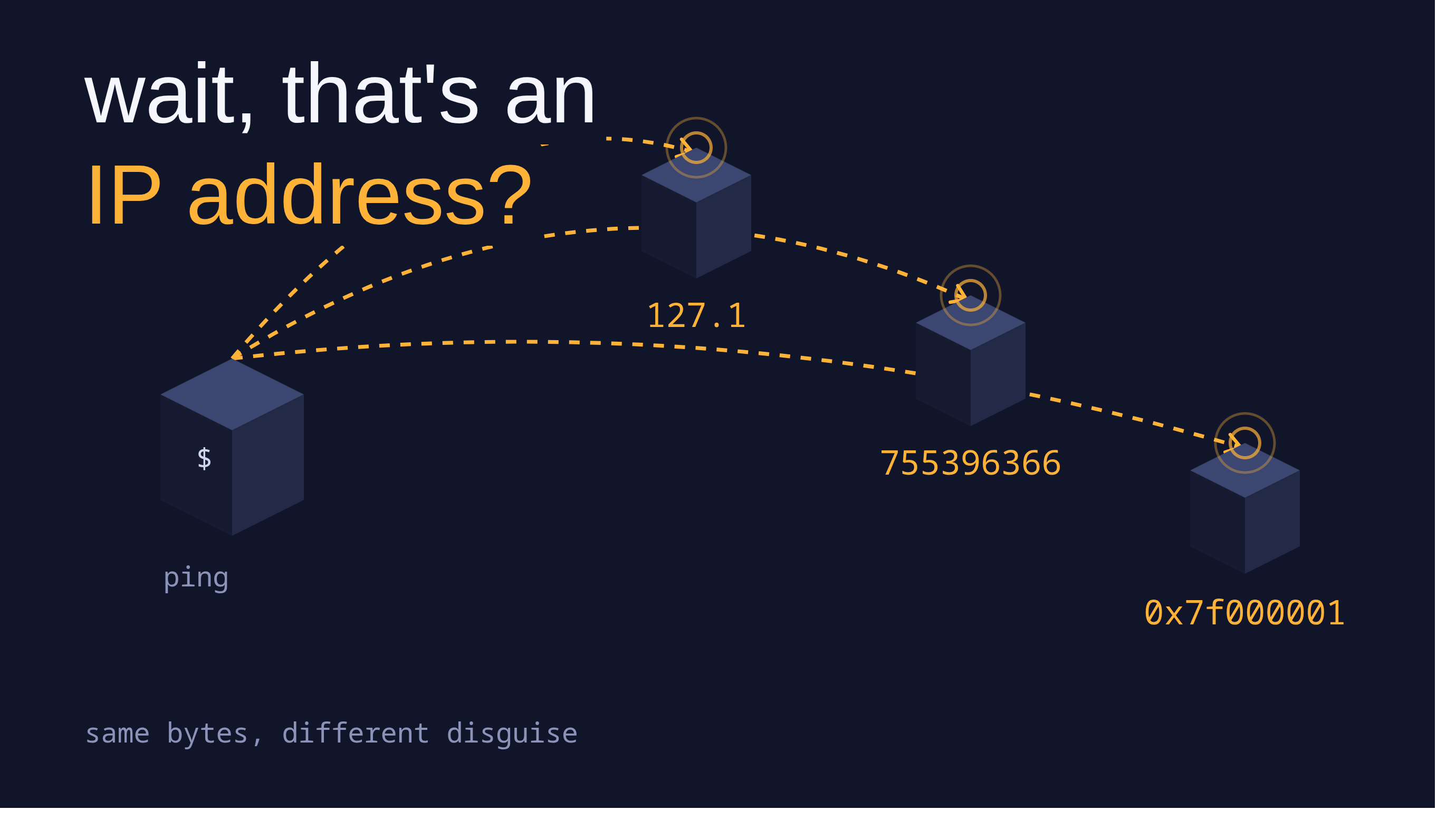
I'll be honest. After years being in cybersecurity, finding out mid-malware-analysis read that 45.39.21646 is a completely valid, resolvable IP address. Genuinely stopped me for a second. My initial assumption was that it could be an obfuscated IP address that the malware would reconstruct later in the execution chain. It wasn't.
It's actually a 40+ year old feature of the networking stack. I suspect many of us have gone years without realizing this behavior has been quietly sitting at the intersection of network history, parser design, and real, current CVEs. So I decided to go all the way down this rabbit hole.
Yes, That's an IP Address
An IPv4 address at its core is just a 32-bit unsigned integer. The dotted-quad notation (192.168.0.1) is a human convenience layer on top of that integer. It's not the only one, and it was never the only one the parsing code accepted.
The classic "shorthand" parser (more on its origin in a second) accepts the address in 1, 2, 3, or 4 parts, and whatever the last part is, it absorbs however many bits are left over:
| Parts | Format | Bit-width of last part | Example | Resolves to |
|---|---|---|---|---|
| 4 | a.b.c.d |
8 bits each | 192.168.0.1 |
192.168.0.1 |
| 3 | a.b.c |
last part = 16 bits | 45.39.21646 |
45.39.84.142 |
| 2 | a.b |
last part = 24 bits | 127.1 |
127.0.0.1 |
| 1 | a |
whole thing = 32 bits | 755396366 |
45.6.111.14 |
And each individual number, in any of those forms, can independently be written in:
Decimal:
84Octal: any value with a leading
0, so0124= 84 decimalHexadecimal: any value with a leading
0x, so0x54= 84 decimal
Not just that you can also mix those bases within the same address. 0x2d.39.0124.216 is a legal way to write 45.39.84.216 (first octet hex, second decimal, third octal, fourth decimal that looks octal but isn't because no leading zero this is exactly the kind of ambiguity that causes bugs, which we'll get to).
Walking through an example
45.39.21646 has 3 parts, so the last number (21646) is a 16-bit value that gets split into the final two octets:
21646 = 84 × 256 + 142
       → high byte = 84
       → low byte  = 142
Result: 45.39.84.142
Converted to other notations, that same address is:
Full decimal integer:
757552270Full hex:
0x2D27548EFull octal (per-octet):
055.047.0124.0216
All four of these strings, along with 45.39.21646, are the exact same destination.
So Why Does This Exist?
According to my research, "no one actually knows" why IPv4 ended up with multiple valid textual notations. There's a lot of speculation around it, but very little hard evidence.
I came to this conclusion - it started unintentionally because how early Unix/BSD networking code implemented IPv4 parsing. Then they kept it as a convenience for network administrators. In the early Internet, addressing was classful. Before CIDR notation (/24) replaced class-based routing in 1993, the first octet determined how much of an address represented the network and how much represented the host.
Under the classful addressing scheme (pre-1993, before CIDR — see RFC 791 and later RFC 1518), IP address space was split into Class A, B, and C networks based on the value of the first octet:
Class A: first octet = network, remaining 24 bits = host
Class B: first two octets = network, remaining 16 bits = host
Class C: first three octets = network, remaining 8 bits = host
If you were an admin sitting on a Class A network like 127.0.0.0/8 (yes, the loopback block is a Class A network) and you wanted to refer to host 1 on that network, typing 127.0.0.1 was needlessly verbose when the system already knew network 127 was 24 bits of host space. So 127.1 became a legitimate, useful shorthand. This is exactly why 127.1 still resolves to 127.0.0.1 today: it's not a coincidence or a bug, it's the shorthand rule working as designed, more than 40 years after classful addressing was formally retired by CIDR in RFC 1519 (1993).
The BSD parser that never really disappeared
This behavior was implemented in the C standard library function inet_aton() ("ASCII to network"), written for BSD at UC Berkeley as part of the original Berkeley Sockets API . The same API that essentially every modern operating system's networking stack still descends from. inet_aton() deliberately accepted decimal, octal, and hex notation, and the 1/2/3/4-part shorthand, as a single lenient parser. It shipped in BSD Unix, got copied into System V, into Linux's glibc, into Windows' inet_addr(), and from there, into essentially every general-purpose IP parser written for the next four decades including the ones inside your browser.
Surprisingly: RFC 791, the 1981 spec that originally defined the Internet Protocol, never actually mandates dotted-decimal text notation at all. It defines the address as 32 bits of binary. Dotted-quad is a documentation and tooling convention that emerged from BBN/ARPANET-era practice, not a formally specified wire format — which is a big part of why so many different, mutually-inconsistent parsers sprang up to read it.
Who Decides What an IPv4 Address Looks Like?
This is the crux of why the trick still works today: there is no single authoritative spec for "what counts as a valid IPv4 address string." Different documents, written decades apart for different purposes, disagree and different pieces of software each pick a different one to implement.
| Spec | Year | What it says about IPv4 text notation |
|---|---|---|
| RFC 791 – Internet Protocol | 1981 | Defines the address as a 32-bit binary field. Says nothing about text notation at all. |
| RFC 1123 – Requirements for Internet Hosts | 1989 | Explicitly warns about the ambiguity between a hostname and an IP literal, and says implementations need extra logic to remove ambiguities — an early acknowledgment of exactly this problem. |
| POSIX.1-2001 | 2001 | Introduced inet_pton(), which converts an address from its standard text presentation form. For IPv4, that means four-part dotted-decimal notation and not the octal, hexadecimal, or abbreviated forms accepted by older interfaces such as inet_aton(). |
| RFC 3986 – URI: Generic Syntax | 2005 | Defines an IPv4 address in URI syntax as exactly four decimal octets, each in the range 0–255. It also explicitly acknowledges that many implementations accept other, platform-dependent IPv4 forms through routines such as gethostbyname() and inet_aton(). |
| WHATWG URL Standard | living standard, IPv4 parsing formalized ~2015 | Defines a concrete IPv4 parsing algorithm for URLs that preserves the legacy forms: one to four parts, hexadecimal, and octal. The parser records those non-decimal forms as validation errors but still converts them to an IPv4 address for compatibility. |
Here's the interesting part: the "official" internet URI standard (RFC 3986) is stricter than what every browser on the planet actually does.
RFC 3986 says that an IPv4 literal in a URI uses four decimal octets. However browsers don't implement RFC 3986's IPv4 grammar. Instead they implement the WHATWG URL Standard, which is a different document maintained by browser vendors, and which explicitly preserves the old BSD leniency because too much of the existing web depended on it by the time anyone tried to standardize it.
And we can see exactly when this became an explicit web-platform standardization problem.
In July 2014, Simon Sapin opened W3C Bug 26431, "Define IPv4 parsing." The issue points out that browsers were already encountering "many interesting variations" of IPv4 syntax and asks the specification to define what should be accepted, normalized, or rejected. At the time different browsers and operating-system networking APIs were handling the same strings differently, which could make equivalent URLs look different or non-equivalent URLs appear similar.
The issue was resolved in 2015, when the IPv4 parser was added to the URL specification.
So you end up with a genuinely strange landscape:
Strict parsers (
inet_pton, most modern security-conscious libraries) → reject anything but four decimal octets.Legacy parsers (
inet_aton,getaddrinfo's numeric-host path, browser URL parsers) → accept the full mess of hex/octal/shorthand.Web URL parsers → own standardized behavior through WHATWG, which intentionally preserves these legacy forms for web compatibility.
Now the problem is not simply that one specification is "right" and another is "wrong." The problem is that the same string can cross multiple software layers, and those layers may apply different parsing rules before they arrive at the same 32-bit destination address.
That's the mismatch we'll keep coming back to throughout this article.
IPv6: Same Idea, Different Rules
I already knew about this one. IPv6's multiple textual representations are fairly well-known compared with the IPv4 tricks we've just looked at. With IPv6, the ambiguity comes from a different place: representation and compression, not the decimal/octal/hex base-switching we saw with IPv4.
The compression rules
An IPv6 address is a 128-bit value, normally written as eight 16-bit groups, or "hextets", in hexadecimal, separated by colons. RFC 4291 defines the basic textual representation and allows leading zeros within each 16-bit field to be omitted.
For example:
2001:0db8:0000:0000:0000:0000:0000:0001
can be shortened to:
2001:db8:0:0:0:0:0:1
and then further compressed to:
2001:db8::1
Here are the important rules:
Leading zeros within a 16-bit group are optional.
0db8anddb8represent the same value.A consecutive run of zero groups can be replaced with
::. RFC 4291 allows::to represent one or more consecutive 16-bit zero groups, and it can appear only once in an address.Hexadecimal letters are case-insensitive.
2001:DB8::1and2001:db8::1are the same address. RFC 5952 later recommends lowercase for canonical representation.::by itself represents the unspecified address,::/128. It is not the same as::1, which is the loopback address. RFC 4291 explicitly defines both representations.
That's already a lot of equally-valid spellings for one address before we even get to IPv4.
And this is where IPv6 gets interesting for the rest of our story. The problem appears when different layers normalize, compare, display, or parse those different representations differently.
The real rabbit hole starts when IPv4 gets embedded inside IPv6.
Where IPv4's tricks reappear inside IPv6
IPv6 has several mechanisms that carry IPv4 information inside a 128-bit IPv6 address. The important distinction is that these mechanisms serve different purposes: some are operating-system representations, some were designed for IPv6 transition, and others are used by translation mechanisms such as NAT64.
IPv4-mapped IPv6 addresses (
::ffff:a.b.c.d): used to represent an IPv4 node as an IPv6 address, particularly in dual-stack APIs and sockets.IPv4-compatible IPv6 addresses (
::a.b.c.d): an older IPv6 transition mechanism that RFC 4291 later deprecated.NAT64 IPv4-embedded addresses: the well-known prefix is
64:ff9b::/96, followed by the embedded IPv4 address. For the/96form, the IPv4 address occupies the low-order 32 bits of the IPv6 address.
All three are different mechanisms, but they share one interesting property: an IPv4 address can appear inside an IPv6 representation.
Here's the part that's easy to miss. Take the IPv4 address:
169.254.169.254
Those four octets are:
169 = 0xA9
254 = 0xFE
169 = 0xA9
254 = 0xFE
So the same 32 bits can be represented either as four decimal octets: 169.254.169.254
or as two 16-bit hexadecimal groups:
a9fe:a9fe
Once those 32 bits are placed into an IPv4-mapped IPv6 address, you therefore get two different textual representations of the same 128-bit IPv6 address:
::ffff:169.254.169.254
::ffff:a9fe:a9fe
They look completely different, but they represent exactly the same address.
You can verify this via ping.
~ ping ::ffff:169.254.169.254
PING ::ffff:169.254.169.254 (::ffff:169.254.169.254) 56 data bytes
6 packets transmitted, 0 received, 100% packet loss, time 5130ms
~ ping ::ffff:a9fe:a9fe
PING ::ffff:a9fe:a9fe (::ffff:169.254.169.254) 56 data bytes
3 packets transmitted, 0 received, 100% packet loss, time 2028ms
And that's where this becomes interesting from a security perspective.
Imagine one component does this:
"Does the string contain 169.254.169.254?"
while another component parses the address and canonicalizes the same destination as:
::ffff:a9fe:a9fe
The two components are now making a security decision based on different textual representations of the same underlying address.
That's the pattern we've been following throughout this article: the dangerous part isn't that multiple representations exist. The dangerous part is when different layers disagree about how those representations should be interpreted, compared, or normalized.
The Actual Parsing Functions
If you're on Linux, you have (at least) three different C-level ways an IP string gets turned into bits, and they behave differently on purpose:
inet_aton() - the legacy, lenient parser
#include <arpa/inet.h>
int inet_aton(const char *cp, struct in_addr *inp);
From the Linux man page (man 3 inet_aton): accepts the 1/2/3/4-part shorthand and decimal/octal/hex per-part notation described above. This is the function whose behavior we've been describing this whole time. It is considered legacy and its use in new code is generally discouraged specifically because of this leniency.
inet_pton() - the strict, modern parser
#include <arpa/inet.h>
int inet_pton(int af, const char *src, void *dst);
It works for IPv4 and IPv6, and only accepts the exact canonical dotted-quad form - four parts, decimal only, each 0–255, no leading zeros. inet_pton(AF_INET, "45.39.21646", &addr) fails. This is the function you want in any code that makes a security decision based on a string that claims to be an IP address.
getaddrinfo() - what your CLI tools actually call
#include <netdb.h>
int getaddrinfo(const char *node, const char *service,
                 const struct addrinfo *hints, struct addrinfo **res);
This is the modern, protocol-agnostic resolution API that tools like ping, curl, and ssh call. Internally, when the string looks purely numeric, glibc's resolver falls back to the legacy, inet_aton-style parsing for backward compatibility.
Think when you run: ping 151587081, will it do DNS resolution?
No, the input can be treated as a numeric IPv4 address rather than a DNS name, and the legacy parser can turn that single integer into its corresponding 32-bit address. No DNS lookup is needed to interpret the number itself. You can easily verify this behavior via WireShark or tcpdump.
~ ping -c1 151587081
PING 151587081 (9.9.9.9) 56(84) bytes of data.
64 bytes from 9.9.9.9: icmp_seq=1 ttl=59 time=111 ms
--- 151587081 ping statistics ---
1 packets transmitted, 1 received, 0% packet loss, time 0ms
rtt min/avg/max/mdev = 110.642/110.642/110.642/0.000 ms
And this legacy behavior is not just sitting in old code nobody touches anymore. NetworkManager's nm-shared-utils.c has explicitly documented that it intentionally uses inet_aton() in a controlled manner to preserve support for legacy IPv4 address forms that inet_pton() does not accept.
Why Does ping Works but the Browser Searches?
This is the sharpest version of the question, and it deserves a proper answer because it trips people up constantly:
Why does
ping 755396366happily resolve to45.6.111.14, but typing755396366into a browser's address bar sends it to your search engine — while45.39.21646gets treated as a navigable address in the same browser?
The answer is that a browser's address bar (the "omnibox") does something ping never has to do: it must first guess whether your input is a URL or a search query, before any IP parsing even happens.
ping's path require one stage:
ping has no such ambiguity. Its argument is expected to be a hostname or address, so:
ping 755396366
        ↓
getaddrinfo()
        ↓
numeric IPv4 parsing
        ↓
45.6.111.14
The browser's path require two stages:
Input classification happens first. The omnibox has to decide what the user is trying to enter: a URL, a search query, or something ambiguous. Chromium's own source code makes this distinction explicit. If there is no scheme, username, port, or known TLD, a single-word input can be treated as ambiguous because it could be an intranet hostname or simply a search term. Chromium therefore defaults these ambiguous single-word inputs to search. "localhost" is an exception. (Chromium source and Chromium Omnibox documentation)
755396366→ a single numeric token with no scheme or dots → treated as ambiguous input → search is the default behavior.45.39.21646→ contains dots and looks structurally like a host → can be treated as a URL candidate.
The URL parser then determines what that URL actually means. Once the input is being handled as a URL, the WHATWG URL parser applies its host-parsing algorithm. That parser still supports the legacy IPv4 forms we've been discussing, including hexadecimal, octal, and 1-, 2-, and 3-part notation. So
45.39.21646can ultimately be parsed and normalized to45.39.84.142. (WHATWG URL Standard)
Firefox had its own interesting location-bar edge case here. Bugzilla #1154245, reported against Firefox 37, documented that entering 127.0.0.1/1 caused Firefox to perform a search instead of loading http://127.0.0.1/1, while 127.0.0.1/x1 loaded normally. The bug specifically affected IP addresses followed by paths containing only numbers. Chromium 37 handled the same URL correctly. Mozilla fixed the issue in Firefox 40.
In the gist:
The difference isn't the IP parser. It's the extra decision layer in the browser.
ping assumes you're giving it a host. The browser's omnibox first has to decide whether your input is a search query or a URL. A bare number like 755396366 is too ambiguous and doesn't look much like a URL, so browser's omnibox treats it as a search by default.
Add a little URL structure:
http://755396366/
and the ambiguity disappears. It's now explicitly a URL, so the browser passes it into the WHATWG URL parser, which can interpret the numeric IPv4 form and resolve it to the same 32-bit address.
Don't @ Me: URL Obfuscation Through Schema Abuse
Notation games aren't limited to the IP address itself. The surrounding URL syntax offers its own obfuscation surface, and it's worth knowing where the boundary between "this article's topic" and "a different, related trick" actually sits.
The userinfo@host trick
RFC 3986 defines a URL's authority component as [userinfo@]host[:port]. Everything before an @ is credentials (historically used for HTTP basic-auth URLs like http://user:pass@example.com/); everything after is the real host. A URL like:
http://google.com@1157586937/
visually reads like a trip to google.com, but google.com is just being sent as a (discarded) username, the actual destination is the decimal-integer IP after the @. This has been documented in real phishing/malware infrastructure by Google/Mandiant's threat intelligence team.
It's a URL-structure trick layered on top of IP notation, not a variant of it, and stacking the two (as real campaigns have done) compounds the confusion for a human glancing at the link. That's why this belongs in the article: the @ trick and the IPv4 notation trick are two separate layers of obfuscation that can be stacked together.
Hands-on, Break It Ourselves
Fire up a terminal. Every command below is safe to run (we're only touching loopback and public DNS resolvers you already trust).
Confirm the shorthand resolves correctly:
# All four of these ping the exact same address (127.0.0.1)
ping -c1 127.0.0.1
ping -c1 127.1
ping -c1 2130706433
ping -c1 0x7f000001
Watch curl do the same thing:
curl -v http://0x08080808/          # decimal-octet hex form of 8.8.8.8
curl -v http://134744072/           # full 32-bit decimal form of 8.8.8.8
Do the conversion yourself in Python 3 (the strict way, using ipaddress):
python3 -c "import ipaddress; print(int(ipaddress.IPv4Address('45.39.84.142')))"
# 757552270

python3 -c "import ipaddress; print(ipaddress.IPv4Address(757552270))"
# 45.39.84.142
Do the conversion the legacy way (using socket, which mirrors libc's inet_aton/inet_ntoa):
python3 -c "
import socket, struct
n = 757552270
print(socket.inet_ntoa(struct.pack('!I', n)))
"
# 45.39.84.142
See the strict parser reject what the legacy one accepts:
python3 -c "import socket; socket.inet_pton(socket.AF_INET, '45.39.21646')"
# socket.error: illegal IP address string passed to inet_pton
Confirm what getent (which goes through NSS/getaddrinfo) does with a numeric string:
getent hosts 755396366
Try the IPv4-mapped IPv6 collapse from section: IPv6: Same Idea, Different Rules:
python3 -c "
import ipaddress
a = ipaddress.IPv6Address('::ffff:169.254.169.254')
print(a.exploded)     # shows the pure hex-group form
"
# 0000:0000:0000:0000:0000:ffff:a9fe:a9fe
Watch it on the wire. If you have tcpdump available, run this in one terminal:
sudo tcpdump -n icmp
...and ping -c1 755396366 in another. You'll see the ICMP packets carrying the plain, canonical dotted-quad address (45.6.111.14) proof that the obfuscation is purely a string-parsing trick. On the wire, in the actual IP header, there has only ever been one 32-bit number. The "weirdness" lives entirely in the human-facing text layer.
How Do We Defend Against This?
If you build or review anything that makes a security decision based on a string that's supposed to be an IP address, the important rule is simple: don't make that decision on the raw string.
Parse it, validate it, canonicalize it, and make the security decision on the address representation that will actually be used for the connection.
The principles
Don't rely on a regex for IPv4 semantics. A rule such as
\d{1,3}\.\d{1,3}\.\d{1,3}\.\d{1,3}only recognizes one visual shape. It doesn't understand decimal integers, hexadecimal, 1/2/3-part notation, or the different meanings that some parsers assign to leading-zero octets.Canonicalize before you compare. Parse the untrusted input into its actual address representation before applying allow-lists, deny-lists, subnet checks, or other access-control rules. Comparing raw strings means you're comparing formatting, not the destination.
Prefer strict parsers for security-sensitive input. In C,
inet_pton()accepts IPv4 only in dotted-decimal form, unlikeinet_aton()andinet_addr(), which accept the broader legacy numbers-and-dots syntax. Python'sipaddressmodule also rejects leading-zero IPv4 strings in current versions, with the strict behavior introduced in Python 3.9.5 and 3.8.12.Reject ambiguous leading zeros rather than guessing. A string such as
012.0.0.1is exactly the sort of input that can mean different addresses to different parsers. CVE-2026-69192 is a current example: the affectedip-addresslibrary interpreted012as decimal12, while the WHATWG URL parser,inet_aton(), andgetaddrinfo()interpreted it as octal10.Validate the destination that will actually be connected to. Don't assume that checking the original hostname or URL string is enough. If possible, resolve hostnames, validate the resulting addresses, account for redirects and DNS rebinding, and ensure the socket ultimately connects to an address that satisfies your policy. The CVE-2026-69192 advisory explicitly calls out this distinction.
Normalize IPv4-mapped IPv6 addresses too. A filter that understands
::ffff:169.254.169.254but doesn't recognize the equivalent::ffff:a9fe:a9fecan still be bypassed. CVE-2026-33975 is a real 2026 example of exactly that normalization mismatch in an SSRF protection layer.
The general rule is:
untrusted string
       ↓
     parse
       ↓
canonical address
       ↓
security policy
       ↓
connect to that validated destination
The important part is that the parser used for the security decision and the representation used for the connection cannot disagree about the destination.
One Last Ping
This blog obviously doesn't cover every corner of it. There is a lot more to explore, especially when you start asking how these representations show up in real network traffic, whether we can reliably capture them on the wire, and what changes when HTTPS gets involved. It's not impossible, but it's not as straightforward either. I'll leave that part to you for now. Let me know if you wanna go down that rabbit hole.
For me, though, the craziest part is still the original trick.
The fact that I can type:
ping 1280054549
and have it actually reach:
76.76.21.21
still feels slightly ridiculous.
Thanks for coming along with me on this journey. And if you spot something in my research that I've got wrong, misunderstood, or could have explained better, feel-free to call it out. I'll genuinely be happy to learn something new.


